





I AM UAA: E.J. David
by Kathleen McCoy |
Assistant Professor of Psychology
B.A. Psychology '02
Hometown: Barrow, Alaska & Metro Manila, Philippines
Fun Fact: He has a tattoo on his upper left arm of his parents, wife, kids and a basketball-the
most important things in his life.
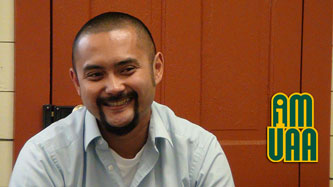
After hearing UAA psychology professor E.J. David's backstory, one word comes to mind:
serendipitous. As a junior in high school he enrolled in the Army thinking that was
his only chance to attend college, under the G.I. Bill. During his senior year, he
qualified for the UA Scholars program, and a full ride to UAA. UA Scholars represent
the top 10 percent of their graduating class. E.J. graduated from Barrow High School
in a class of 45 students, so he was in the top five people of his class.
"I wasn't planning on being in the top 10 percent of my class," E.J. claims. "It just
so happened that I got good enough grades to make sure that I stayed eligible to play
basketball. It was really by accident!"
Laughing about the unexpected turn of events, E.J. says it wasn't too hard a decision
to break up with the Army and choose to go straight to college. Again by chance, since
he was a UA Scholar, he was placed in the university honors program.
"Yeah, I was in it by default," he admits. "But the Honors Program was so invaluable.
It really guided me, challenged me, mentored me and helped me navigate the whole university
system." It was because of this guidance that he was able to finish his bachelor's
degree in three years.
By graduation, the fine-arts-turned-psychology major already had his sights set on
graduate school.
"I was really inspired by one of my professors, John Petraitis," E.J. says. "I saw
what he was doing and how well he was doing it-teaching, being a professor-and that
gave me direction. I wanted to be that; I wanted to do what he was doing; it looked
fun. So I asked him, 'what do I need to do, to do what you do' and he said I needed
to go get my Ph.D. So I decided pretty quickly after I declared psychology as my major
that I was going to go to grad school."
A year away from finishing his doctoral work, E.J. heard from UAA again.
"They were looking for faculty [for their then-new Ph.D. program in clinical-community
psychology] and they contacted me to ask if I would be interested in applying," E.J.
laughs. "This was the only job I applied for out of grad school because this is really
where I wanted to be. To me, there's really no better way to pay back UAA and to pay
back Alaska, for all the opportunities and the blessings that they have provided for
me, than to do what I'm doing now."
So call it serendipity, or just being in the right place at the right time, but what
E.J. has gone on to do from being a young Filipino immigrant in junior high to a leading
and award-winning researcher in cross-cultural psychology speaks volumes for his own
hard work and intentions for thinking critically about the world around him, and helping
others do the same.
Like many Filipino families, E.J.'s parents felt that there was better opportunity
to be found in the U.S. than in the Philippines. His father moved to the States when
E.J. was about 5 years old, returning only one month each year to visit. In the interim,
his dad would exchange cassette tapes with his children so they could hear each other's
voices. Skype didn't exist at the time (believe it or not) and E.J.'s home didn't
have a telephone. His father would also send VHS tapes of the Cartoon Channel-E.J.
was a sponge for anything American by the time he was done watching, commercials and
all.
"The message was that America was this magical place," E.J. says. "Life looked so
easy for American kids and they had the coolest toys and looked like they were having
so much fun. I wanted to get what they had and go where they were. Everyone dreamed
of moving to the U.S., it was normal, it was the context that I grew up in."
By the time he was a little older, E.J. noticed that attitude grow a little more extreme.
"When I was around 8 or 9, I started realizing that a lot of people were using skin
whitening products, even some of my family members, and encouraging me to use those
products, so I'd have lighter skin so I'd be more attractive," he says. "Again the
message was that I needed to be more like the typical American. And English is the
primary means of instruction in the Philippines-giving us the message that it is the
language of the educated, of the higher class."
It wasn't until E.J. moved to Barrow, Alaska, with his younger brother to live with
their father, that he really started to think critically about his ethnicity and what
it meant to be Filipino versus Filipino-American versus American. The climate in the
Philippines was that it was normal to want to reach for America. Living in Barrow,
E.J. experienced his first instances of discrimination, both inside and outside of
his own ethnic group.
"The message I got there was that in order for me to be accepted, I needed to get
rid of my Filipino-ness," he explains. "So I worked really hard on that, with my mannerisms,
with the way I talked, with the way I acted."
Then, before a big basketball game one semester in high school, he found a message
on his locker: "You're Filipino-act like it."
"At that point I had really started denying my Filipino-ness," he says. "In the process
of trying to fit in, I actually began discriminating against other Filipinos, making
fun of the way they spoke English, or avoiding them and not hanging out with them."
Something clicked with the message on his locker. And when he took his first psychology
class at UAA, he finally found a way he could get some answers. For the last 10 years,
E.J. has dedicated his energy and research to issues of colonialism, internalized
oppression and indigenous psychology.
"One of the take-home messages [from my research] is that we live in a multi-cultural
world, especially in the United States, especially in Alaska. Alaska is very diverse
culturally-so we have a lot of different world views, a lot of different values and
belief systems, and that's natural. The more important message is that we need to
learn to value all of these cultures and worldviews equally."
The author of two books, "Brown Skin, White Minds: Filipino-/American Postcolonial
Psychology" (revised edition due out in 2013) and "Internalized Oppression: The Psychology
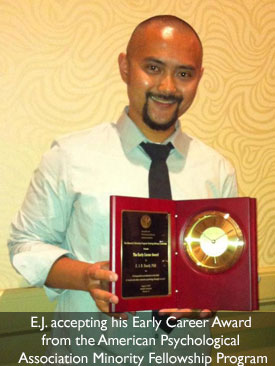
of Marginalized Groups" (due out in 2014), E.J. has also won awards for his research
focus. First an APA Distinguished Student Research Award for his doctoral dissertation
and more recently an Early Career Award in Research for Distinguished Contributions
to the Field of Racial and Ethnic Minority Psychology, given to scientists who are
only 5-10 years past earning their Ph.D.
"My new book covers internalized oppression in other racial groups, as well as internalized
oppression among women, among people with disabilities, and among LGBT folks," he
says. "Internalized oppression is a universal thing, it's not just racial and it's
not just a Filipino or Filipino-American issue."
The father of two children, and a third on the way, E.J. wants most to teach them
the value of identity and culture. His wife is Athabascan, so "I call my kids Filibascan,"
he jokes. "But they are also American. All those parts of them are important and I
don't want them to grow up valuing one over the other. I want them to value all their
identities equally, and for them to be able to do that they need the help of other
people, the help of society."
As an alum, E.J. is thrilled that his professional life is at UAA. As a professor,
he couldn't be happier. "UAA is on the verge of significant growth and I think people
need to realize that. There are a lot of exciting things happening here."
For more on E.J. and his research, visit www.colonialmentality.com.
 "I AM UAA: E.J. David" is licensed under a Creative Commons Attribution-NonCommercial 4.0 International License.