


Device developed by UAA students launched into space aboard NASA rocket
by Keenan James Britt |
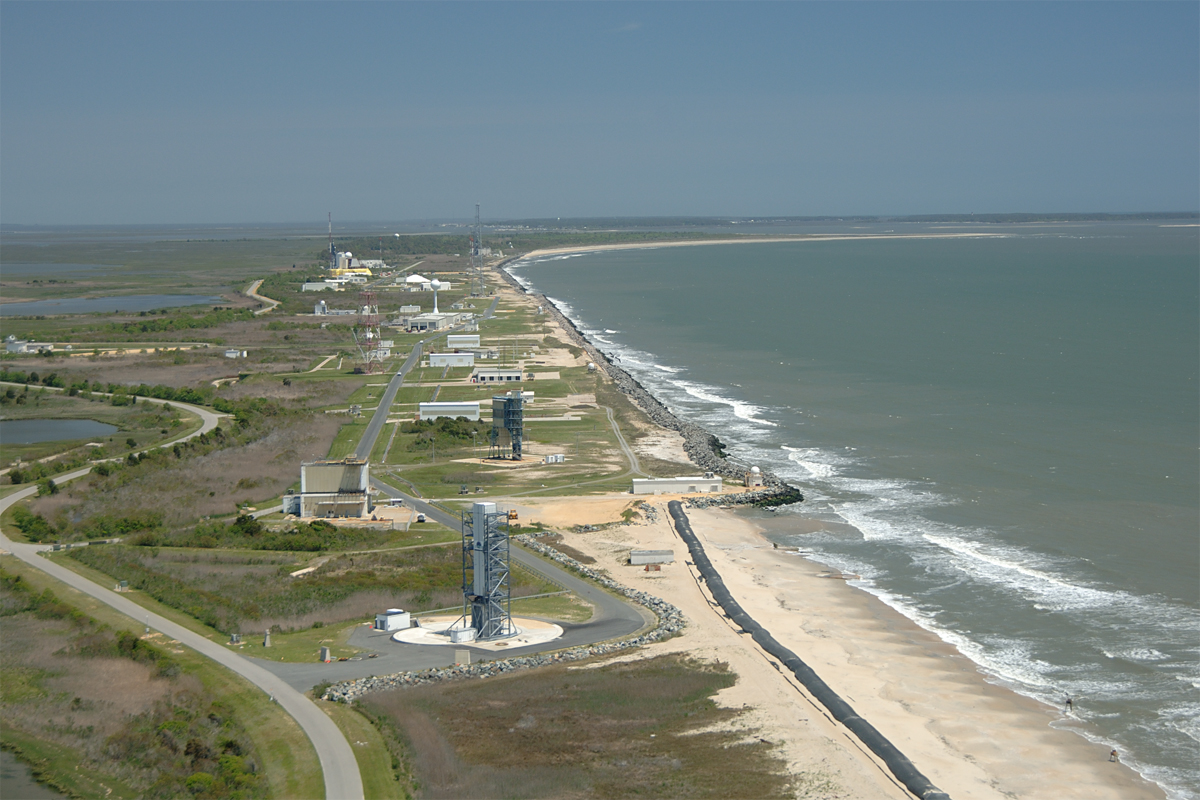
At 5:30 a.m. EST, on June 26, a team of students and faculty from Mat-Su College and the UAA Anchorage campus watched as a Terrier-Orion sounding rocket launched into space from NASA’s Wallops Flight Facility in Virginia. The rocket’s payload included a device designed by the team that was used to measure the mass of the Earth.
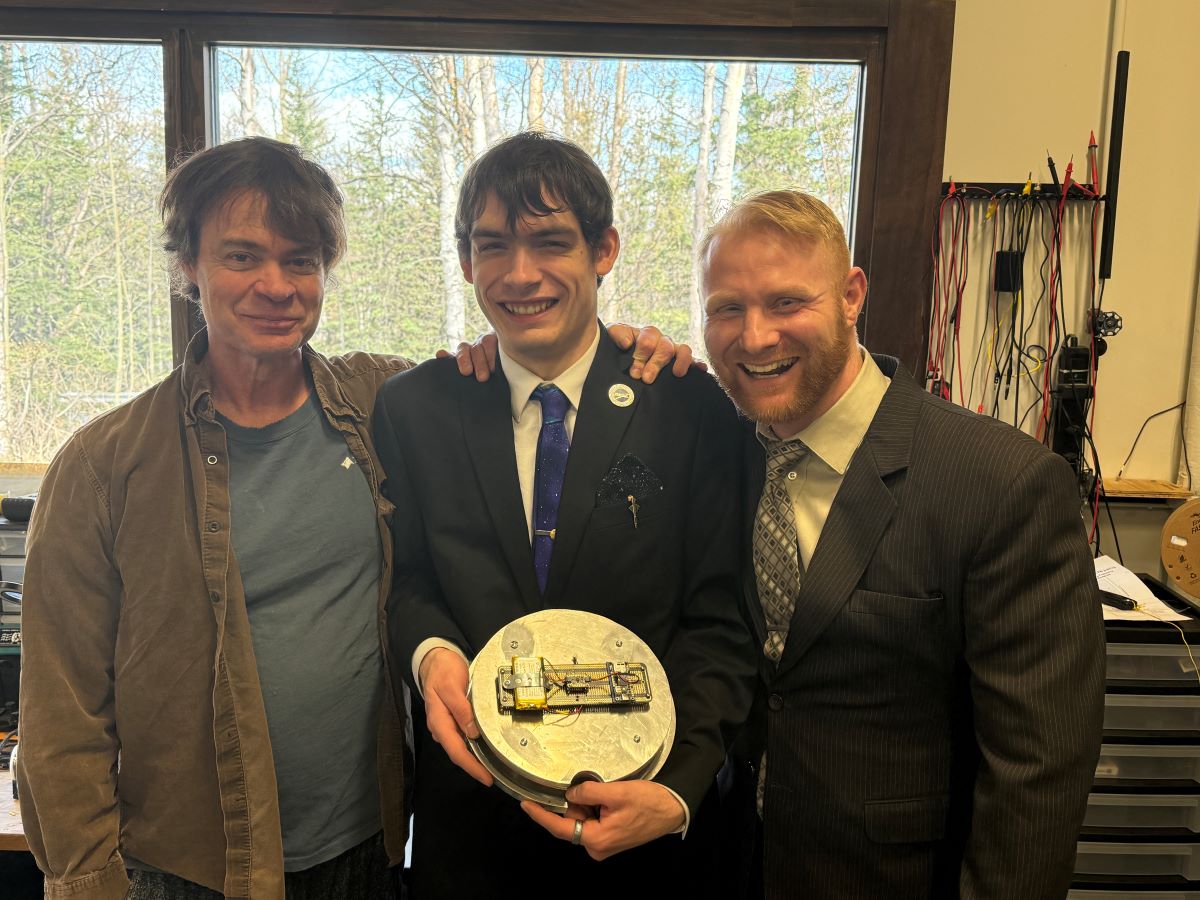
The team consisted of UAA students Justice Darby, Walter Nagel and Kenneth Sparks, and faculty advisor Dan Nichols, Ph.D., associate professor of physics at Mat-Su College. The opportunity came as part of NASA’s RockSat-C program, which allows students to design experiments to fly aboard sub-orbital rockets.
Designing the device
According to NASA, selection for the RockSat-C program is highly competitive due to the limited space aboard the rocket, and only “the most advanced payloads and well-prepared teams will be selected for flight.”
Designing and constructing the device took a wide range of engineering skills, including electronics, software engineering, data analysis and project management.
Darby, an undergraduate in mechanical engineering who takes courses at both the UAA Anchorage campus and Mat-Su College, had a childhood fascination with space, and initially wanted to be an astronomer, but was drawn to rocket science because of the mathematics and theory involved. Designing the software for the device provided Darby with plenty of applied experience with advanced mathematics.
“We had to build [the software] up ourselves. It was kind of a giant mess,” said Darby. “It definitely bogged Dan [Nichols] and I down for several months to figure out what all these Euler angles and quaternions were.”
According to Darby, the device used two sensors to measure the “magnetic field, the acceleration of the rocket and the spin rate of the rocket” within the frame of the rocket.
“Our data analysis took that data [...] and reorientated it back to the Earth to do the calculations,” Darby explained.
The team developed their own software to analyze the data collected by the device in order to calculate Earth’s mass. The team wrote the software in the MATLAB programming language.
“We took the data that we got from a rocket and then just shoved it onto a spreadsheet and fed it through MATLAB to get our results,” said Darby.
Nichols, the team’s faculty advisor, said in a statement that the software the students developed during the project “will be used by future generations of students working on rocketry experiments, forming a foundation for continued innovation and learning.”
Practical applications for the device
RockOn Student Sounding Rocket Launch - June 26, 2025
While the Earth’s mass is already known to science, Darby believes the device the team constructed could one day be used to help measure the mass for other bodies in the solar system.
“The same physics should apply to Mars,” Darby said. “The biggest constraining factor would be how far out of the atmosphere [the device is], because if you can get far away enough from the atmosphere, then drag shouldn't be as much of an issue.”
Darby believes that the device would be able to determine the mass of rocky planets and moons, though it would likely struggle with planets with thick atmospheres, like Venus.
“So it'd be most easy to do on planets or objects that have a high enough gravity that [the payload] will eventually come back down, but also a thin enough atmosphere that drag shouldn't conflict with any of the numbers,” Darby explained.
For now, Darby’s immediate goals for after graduation are more down-to-earth.
“My goal — I will not lie — [is to] get to Marshall Space Flight Center in Huntsville, Alabama,” said Darby. “They're actually the main center that works on a lot of the theoretical rocketry. They developed the Saturn moon rocket for the Apollo program, and they're also building the current moon rocket for the Artemis program.”
 "Device developed by UAA students launched into space aboard NASA rocket" is licensed under a Creative Commons Attribution-NonCommercial 4.0 International License.