




Alumni Spotlight: Tara Schmidt - on leveraging relationships in school and beyond
by Alison Miller |
Tara Schmidt is an alumna of the Division of Population Health Sciences Master of Public Health program. Now a research professional at the University of Michigan, she draws on her graduate training to strengthen community engagement in research across Alaska, with a focus on suicide prevention and substance use. In this spotlight, she reflects on how her time at UAA shaped her career path—from the relationships that opened doors and guided her forward to the unexpected milestones, like learning to swim in the UAA pool at age 29.
Name: Tara Schmidt
Educational background: Master's of Public Health (MPH), UAA 2020; Bachelor's in Broadcasting and Electronic Media Studies (BA), Gonzaga University 2012
Unit you graduated from: Div. of Population Health Sciences
Hometown: Nome, AK
Current location: Homer, AK
Place of employment: University of Michigan
Job title: Research Associate Senior for the Promoting Community Conversations about Research for Effective Solutions (PC CARES) program.
How long have you worked at this organization and/or been in this position?:
I've been working on PC CARES-related research for seven years, and for the University
of Michigan for five years.
Please describe your duties and responsibilities in your current role.:
My role focuses on community-based participatory research for the Promoting Community
Conversations about Research for Effective Solutions (PC CARES) program. PC CARES
research is housed at University of Michigan, but most of its projects are based in
Alaska. One of my roles in PC CARES research is to build meaningful community involvement
in research through local steering committees and communications. I am also a PC CARES
trainer, and in that capacity I facilitate workshops that strengthen local capacity
to reduce suicide and prevent substance use through research-informed, community-driven
solutions.
What impact does your work have on individuals and communities?:
PC CARES focuses on how to make research useful for communities, and how communities
can make decisions for themselves to improve and save lives. It’s a hopeful approach
to big, impossible-seeming problems. The Research and Program Evaluation track at
UAA's School of Public Health gave me the knowledge, and a Graduate Research Assistant-ship
gave me the experience I needed to answer those questions.
What motivated you to pursue a career in public health?:
After working in community settings for a number of years where I focused on violence
prevention, healthy relationships, and positive youth development, I wanted to know
about how we can measure the impacts of these social programs on the individuals,
their relationships, and their community environments.
Why did you choose to attend UAA?:
When I went back to school, I didn't imagine it would lead me to be a course instructor
at UAA. This summer I'll be instructing a unique summer course that will prepare students
to be local facilitators for the PC CARES At-Risk Substance Use initiative, where
they’ll lead conversations for change within their community based on locally relevant,
actionable research. For the past year and a half, we have been working with a Community
Advisory Board with support from the state of Alaska Office of Substance Misuse and
Addiction Prevention (OSMAP), and I am looking forward to seeing the curriculum and
program we've worked so hard on come alive in communities across the state.
How has your education at UAA College of Health helped you contribute to your community
and make a positive impact in the lives of others?:
During my practicum year, and throughout the electives I took in the program, I had
the freedom to customize my educational experience to what interested me most, and
had ample opportunity and encouragement to partner with local organizations outside
the classroom. Those relationships I built have lasted far beyond the classroom, and
it's through relationships that we can begin to positively influence health and well-being.
What advice do you have for current students who want to make the most out of their
experience at UAA and build a successful career in healthcare?:
At every opportunity you can, take your learning outside the classroom (or the Blackboard/Canvas
discussion boards). UAA's faculty make sure that real-world experience is integrated
and important to your studies.
Can you share a particularly rewarding experience from your career that you're proud
of?:
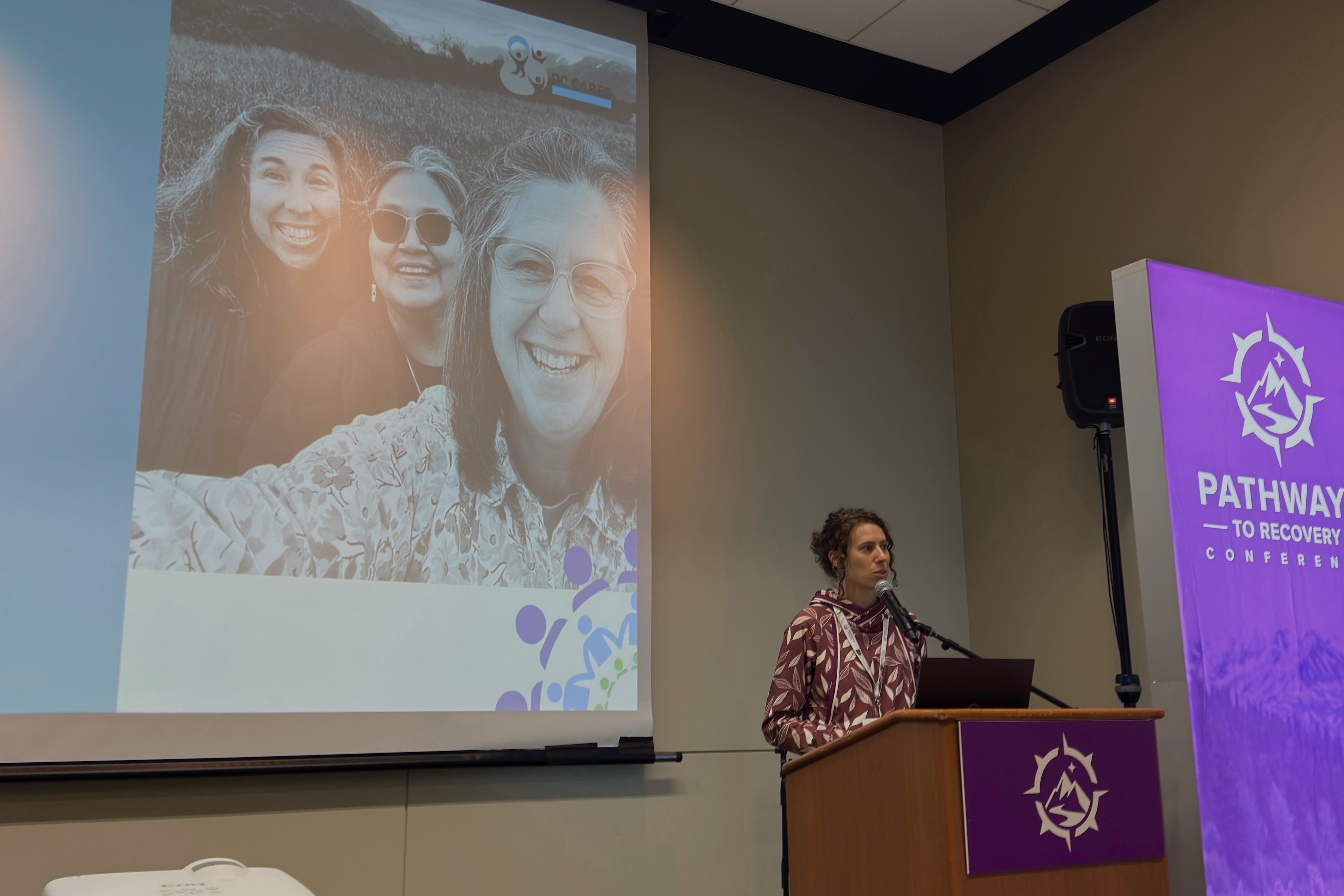
Last spring, the PC CARES At-Risk Substance Use team presented at the Pathways to
Recovery Conference at the Dena'ina Center. In a room of 50-60 advocates, community
educators, service providers, and change makers, people were truly energized by conversations
about a "bite-sized" research insight about stigma and substance use. These rich conversations
can be a catalyst for change on many levels – be it internal, in the ways we interact
with others, or the ways we approach substance use.
What is something people may not know about you?:
I spent a winter living in Anchorage while working as a Graduate Research Assistant
and decided to take a swimming class at UAA, so I learned to swim at age 29.