








Community Engaged and Service Learning Courses
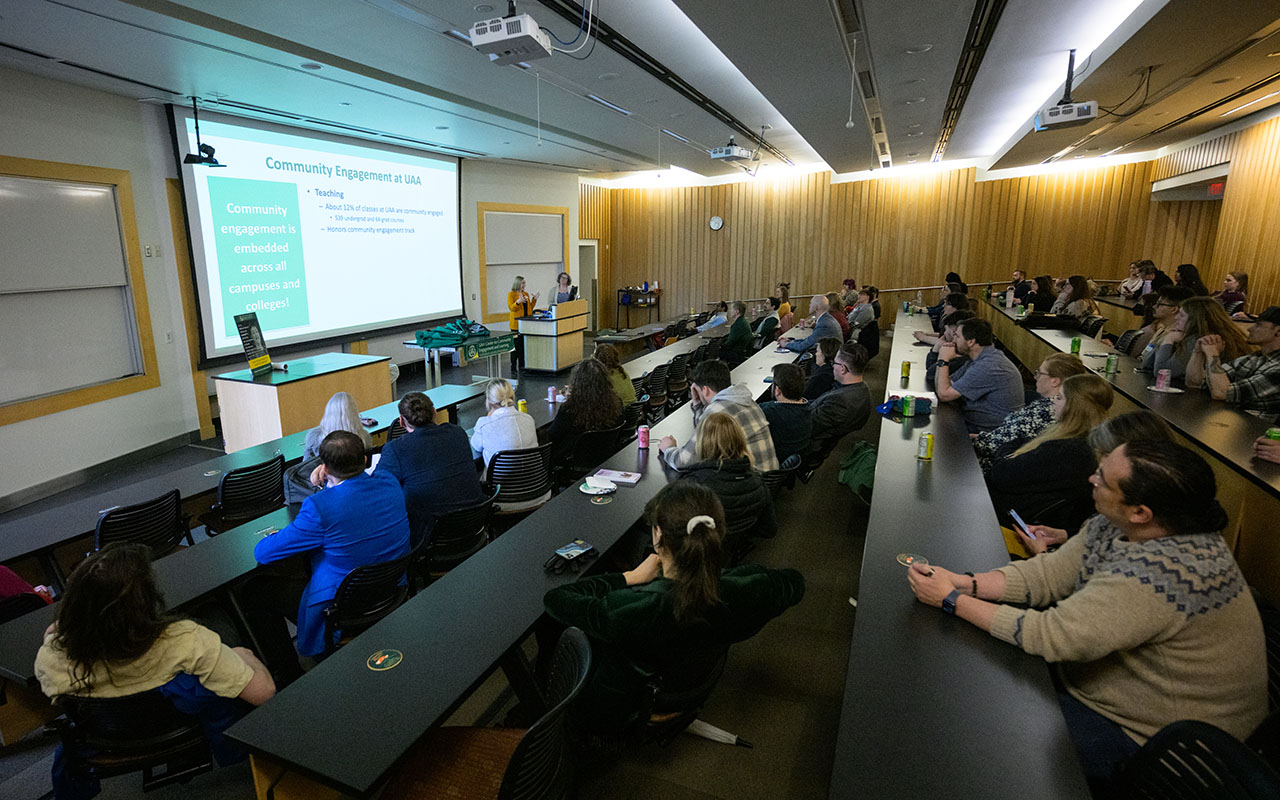
Community Engaged (CE) and Service Learning (SL) courses break down classroom walls by connecting academic learning with real-world skills and impact through meaningful partnerships that benefit students, faculty, and communities across Alaska, including Anchorage, Kenai, Valdez, Mat-Su, and Homer. Explore the information below to learn about course designations and available opportunities.
Students, find eligible courses here: Fall 2026 Community Engaged (CE) Courses and Fall 2026 Service Learning (SL) Courses
(Page not loading? You must be using campus internet or connected through the VPN to access these pages!)
Information on CE/SL courses
SL/CE Course Designations
The UAA Faculty Senate approved definitions for community engaged academic curriculum in Spring 2014. A course may be designated Community Engaged (CE) or Service Learning (SL) but not both. These designations help UAA recognize and track community-engaged teaching for institutional assessment, accreditation, and reporting.
Not sure which designation fits your course? The definitions below explain the differences:
Definitions
- Service Learning
Service Learning (SL)
The SL designation, by definition, asks more of the faculty and the students in designing a significant experience based in the community and asks that issues of impact, sustainability and reciprocity be addressed with the community partner. Additional guidelines are to prepare students for service roles, structure reflection, and address evaluation of impact for students and community.
A Service Learning course is a community-engaged course which integrates the service learning more deeply and more intentionally. At a minimum, the course should have:
- Service: significant community-based work work defined in response to a need or aspiration presented by one or more partnering community organizations and for which core issues of impact, sustainability and reciprocity have been addressed.
- Clear linkage between the service and student learning outcomes: both academic and civic learning are addressed, and this is communicated in the syllabus.
- Preparation for service: students are prepared for the roles they will play, including engaging respectfully with a community that may differ significantly in race, class, age, or other elements of social identity.
- Structured reflection: intentional, systematic reflection on students' experience in the community is integrated throughout the course, not added as a one-time or final assignment. Reflection activities may include talking, writing or other means, and may be individual, group-based, or both.
- Evaluation: assessment of student learning and community impact has been planned. This could consist of asking the CCEL to survey the community partner and students, or could be instructor-designed assessment activities.
- Community Engaged
Community Engaged (CE)
The designation of a CE course may apply to a broad spectrum of courses that could include a wide variety of experiences and activities. There may be a portion of the course or a set of assignments that require the students' interaction with the community and/or community issues that does not carry throughout the semester. Activities might be indirect or direct service to a community organization or individuals and could potentially take place entirely in the classroom. The broad definition may sometimes capture work that is exploratory for faculty beginning to engage with community in their courses, bring an application of theory to practice that is appropriate for only part of a course, or requires a relatively low level of community interaction due to large course size or other considerations that do not favor intensive engagement.
A Community Engaged course involves the student(s) in some kind of work outside of the classroom that contributes to the public good. At a minimum, the course should:
- Design and implement the community work with appropriate community input so that the students' efforts will provide an identifiable public benefit rather than a community burden.
- Clearly link the community work to student learning outcomes in the syllabus.
- Engage students in some oral or written reflection that explores their experience of engagement and connects it with the course learning goals.
Definitions Approved by UAA Faculty Senate on March 7, 2014
Definitions and parameters were taken and modified from University of Massachusetts Amherst Office of Civic & Service Learning
How to Designate UAA Courses
Department schedulers can designate courses through the CLSS online scheduling system, hosted by the UAA Office of the Registrar. To request access to CLSS please contact uaa_publications@alaska.edu. Basic instructions to help you get started in CLSS can be found on the Curric website.
To designate a course:
- Enter the Banner code, SL or CE, in the 'Attn Method' field, located in the enrollment section of the Edit Section window
- Click 'Save Section'
- Repeat for each course and section
Individual or Departmental Consultations
Need help? Contact CCEL at uaa.ccel@alaska.edu.Take a Community Engaged Course
Are you interested in connecting your in-class learning to community issues? Or would you like a hands-on opportunity to assist a faculty member with their community-focused research or project? Those are just a few of the ways that UAA students can connect their learning to their community. Read about the community engagement opportunities available at UAA below.
Civic Engagement (CEL) Courses
Whether you are interested in environmental policy, arts, economics, or anything in between, civic engagement courses can help you broaden the reach of your professional and academic goals.
Course Descriptions
- CEL A292- Introduction to Civic Engagement
Introduces students to types of civic engagement in a democracy, practices of engagement and inquiry, and public issues of ethics, environmental sustainability, community building and human and civil rights through reading, reflections and community inquiry. A service-learning component is included and a required part of the course.
3 Credit Hours
- CEL A395-Civic Engagement Internship
Internship in which student gains intensive experience applying principles of civic engagement and major-disciplinary knowledge and skills to a community-identified problem. Students complete approximately 135 hours, usually in a community non-profit or government agency.
6 Credit Hours
Available Civic Engagement Courses by Semester
Honors Community Engagement Track
The Honors College offers a Community Engagement track, which “prepares students to be engaged community members. Students will acquire the knowledge, skills, and abilities required to participate in civic life through the provision of service and assistance to their communities.” Please visit their website to learn more.