





Due to unsafe road conditions for Anchorage and surrounding areas, UAA’s Anchorage campus will be on a delayed start today, Thursday, Dec. 4. Campus will open at 10 a.m. to allow for safer travel.
10 Year Anniversary
2009-2019
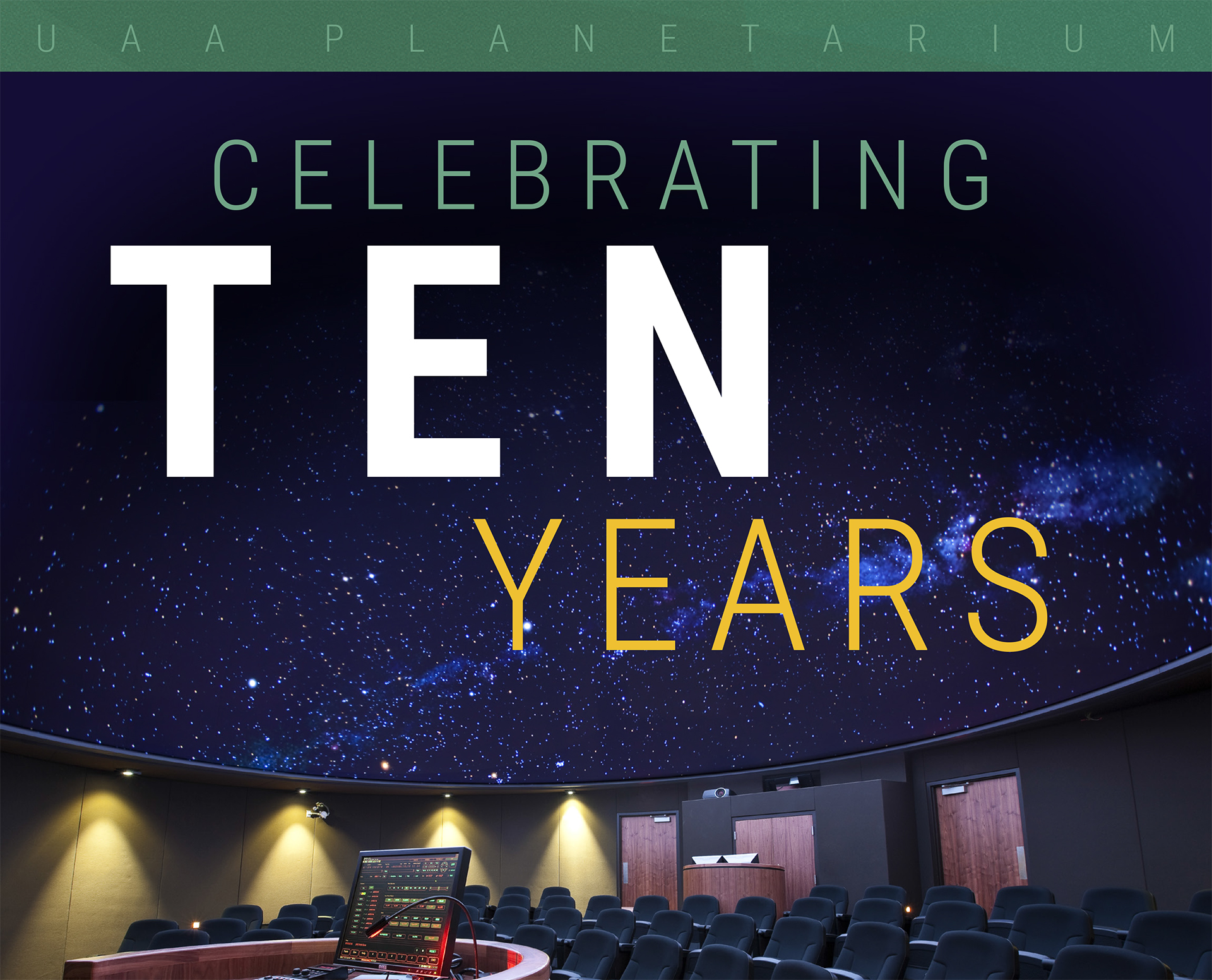
The UAA Planetarium debuted as the largest in Alaska 10 years ago during the opening of the ConocoPhillips Integrated Science Building. Our facility was designed to be an exceptional tool for astronomy classes, data visualization, and research. Shortly after opening, we started inviting the community to share in our space with public shows on Friday nights and private shows for school and youth groups (and some wonderlust adults). These shows bring the latest in UAA research and expertise to the public in very immersive ways. Ten years later, we have had almost 100,000 visitors and are still getting new shows every semester!
Something to Celebrate!
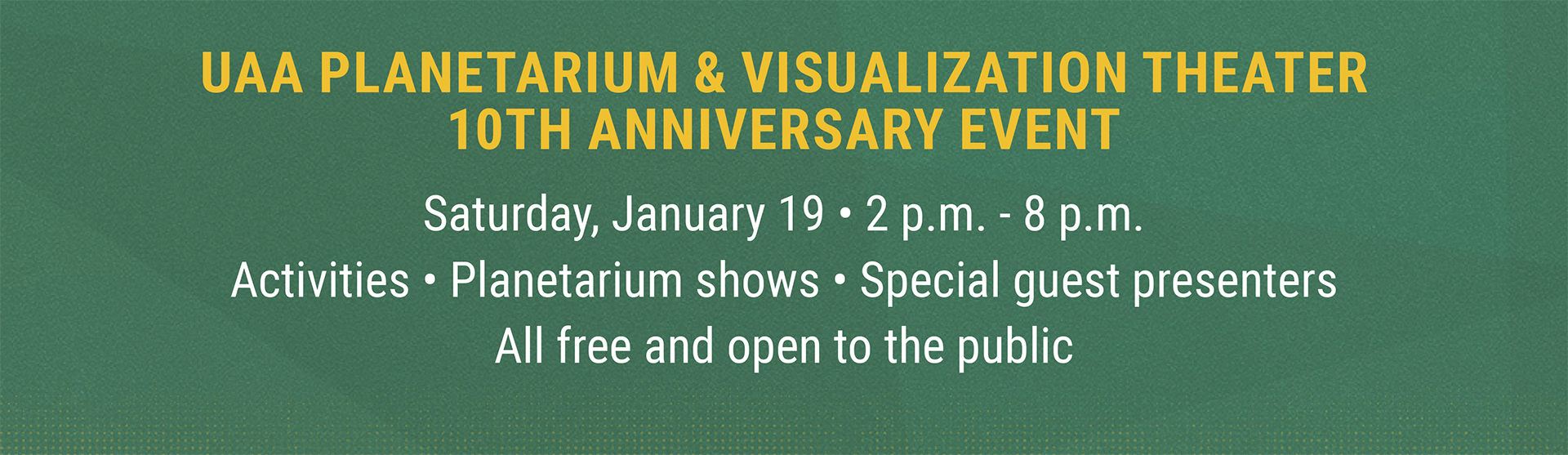
Come and join us for a celebration of our 10 Year Anniversary on Saturday, January 19th. We will have free planetarium shows, hands-on activities, giveaways and special guest presenters.
Schedule of Events
Activities will be going on in the Atrium of the ConocoPhilips Science Building from 2pm-8pm
- Planetarium Show Schedule
- 2:00 - Above Alaska
- 2:30 - Magic Tree House: Space Mission
- 3:00 - River of Bears
- 3:30 - "Salmon and Environmental Changes on the Kenai Peninsula" with Frank Witmer
- 4:30 - Kiuguyat
- 5:00 - Black Holes
- 5:30 - Escher's Universe
- 6:00 - Nanocam
- 6:30 - Stars of the Alaskan Sky with Omega Smith
- 7:00 -"There and Back Again: A Tale of Asteroid Orbits and Uncertainty" with first planetarium director, Dr Andy Puckett
Guest Presenters
Andrew Puckett, PhD
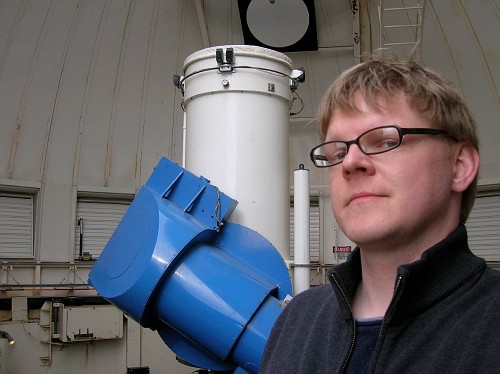
Andy came to Alaska in 2007, shortly after earning his PhD in Astronomy and Astrophysics from the University of Chicago. For the first 3 years he worked with Dr. Travis Rector as a postdoctoral researcher and lab instructor, developing authentic undergraduate research projects which continue to be used in UAA’s intro astronomy lab curriculum. He began working with the Planetarium and Visualization Theater as soon as it was completed in 2009, and took over as UAA’s first full-time Planetarium Director in 2010. During the next 3 years, Andy scheduled and presented/supervised over 500 shows for both K-12 and public audiences, and also taught one college astronomy course on the dome every semester. He wrote grants that bought hardware to improve the real-time visualization capabilities of the planetarium, and that provided seed funding for the homegrown full-dome aurora show that became “Above Alaska.”
In 2013, Andy took a job in the Department of Earth & Space Sciences at Columbus
State University in Georgia, where he is now a tenured Associate Professor of Physics
and Astronomy. He teaches courses ranging from gen-ed introductory classes to upper-level
courses like 20th Century Physics, and Physics Chemistry and Geology of the Solar
System. Whenever he teaches introductory solar system astronomy, he channels his
planetarium-director past by making ample use of CSU's 110-seat Omnisphere Theater
to give students a three-dimensional view of the motions of the sun, moon, and planets.
He also continues to mentor undergraduate students in asteroid orbit refinement projects,
including Astrophysics & Planetary Geology majors who have helped determine the initial
orbits of 8 recently-discovered Near-Earth Objects, resulting in publications in the
Minor Planet Electronic Circulars. In 2016 he earned the Outstanding Mentorship Award
from CSU's Honors College, and in 2015 the main-belt asteroid (184011) Andypuckett
was named in his honor. He and his wife Becca live in Columbus, Georgia, with their
daughter Maia (11) and sons Jack (8) and Ben (5).
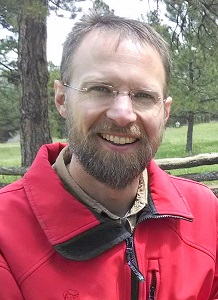
Frank Witmer, PhD
Frank Witmer is a computational geographer who conducts research in violent conflict and human-environment interactions using spatial statistical methods, remote sensing data, and simulation. He also uses immersive visualization technology in the Planetarium and Visualization Theater (PVT) to study the effects of environmental changes on salmon and Alaska fisheries. He currently teaches classes in both the Computer Science and Geomatics departments at UAA.