








IT Governance
IT Governance & IT Management
IT Governance
IT Governance is the capability that evaluates, directs, and monitors major decisions on the appropriate use of enterprise IT assets to achieve business outcomes through empowerment of the right leadership to sponsor, make and enforce the right IT decisions. IT Governance is focused on major IT decisions that involve significant investment, risk, or impact to ensure alignment with the university's strategic direction and goals.
The IT Governance Structure at UAA and the UA system ensure alignment between UAA's institutional strategy and business outcomes and technology infrastructure, portfolio, and services.
IT Management
IT Management is focused on Information Technology strategy, technology, and operations in support of university strategic goals and operations. IT Management is empowered to set strategy and make decisions below the investment, risk, and impact threshholds requiring IT Governance decisions. ITS, led by the Office of the CIO, is the principal department that leads UAA's Information Technology function.
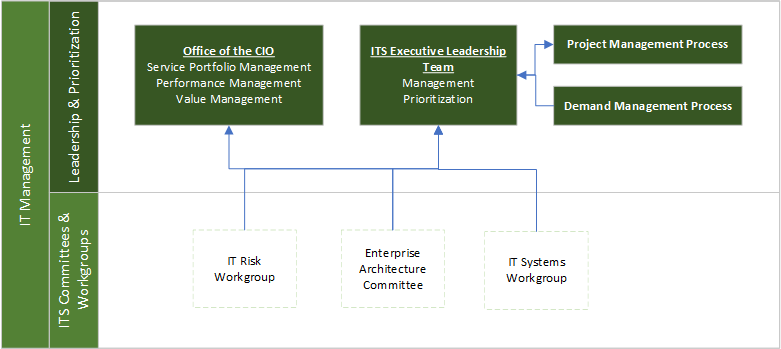
IT Governance
Enterprise IT Governance is the capability that evaluates, directs, and monitors decisions on the appropriate use of enterprise IT assets to achieve business outcomes through empowerment of the right leadership to sponsor, make and enforce the right IT decisions.
Vision
To define and promote a coordinated IT governance structure that facilitates effective and collaborative IT decision-making in service to the university's needs and in alignment with University of Alaska Anchorage’s mission and strategic plan.
IT Governance Goals
- To establish a unified and coordinated model for IT governance at the university
- To develop clear processes and communication paths for escalation of recommendations between governance committees.
- To ensure that IT work and service offerings meet the university's academic, research, and administrative needs.
- To increase consistency and transparency in decision-making and prioritization of initiatives.
IT Governance Layers
- Executive Committees
- Executive layer committees exercise the highest level of oversight and guidance for the IT function at UAA. Membership is small and represents broad decision-making authority for the university leadership.
- Domain Committees
- ITG Committees are broader in membership than the executive committee and exercise mid-level guidance and authority at UAA. Each committee is focused on a specific critical domain of IT services.
- Function & Product Committees
- Governance bodies that are dedicated to a specific service, function, or product are unusual but sometime needed to do complexity and breadth of application across other domains. An example might be TDX Governance as it is a single product that is now used heavily by IT units across the UA system as well as non-IT units. Governance of the Identity and Access Management function is another common example.
IT Governance Bodies
- Executive
- IT Executive Board (UAA) - Planned
- CMT (UA System Scope) - (Current)
- Domain
- Academic Technology Committee - Planned
- Research Technology Committee - Planned
- Administrative Technology Committee - Planned
- IT Systems & Risk Committee - Planned
- Function, Product, or Center of Excellence
- UA TDX Governance Council (Current)
- Student LMS Governance Committee (Planned)
- Website Steering Committee (Current)
Current IT Governance Bodies
| Group | Type | Scope | Chair | Reports to | Charter |
| CIO Management Team (CMT) | Executive | Systemwide | UA System Office CITO | N/A | In Progress |
| Website Steering Committee | Function | UAA | UAA CIO | IT Executive Board | UAA Website Steering Group |
| UA TDX Governance Council | Product | Systemwide | UAA CIO | CMT | UA TDX Governance Council Charter |
Process & Operations
To be effective, committees need defined operating processes and a person or group of people to support their ongoing operation, such as developing materials for meetings, taking meeting minutes, tracking metrics, and moving decisions across the governance structure.
Roles & Responsibilities
Chairs’ Responsibilities
- Provide leadership and direction to the committee, and establish its goals and objectives, to facilitate the work of the university in pursuing its vision, mission, and strategic direction.
- Guide the work of the committee to be consistent with its scope of authority and that issues of interest to other committees or to the wider university are appropriately referred.
- Guide the committee in making clear and unambiguous decisions and in appropriately allocating responsibility for advancing action items.
- Lead the planning and development of meeting agendas, in consultation with the IT governance support staff.
Member Responsibilities
- Take a strategic, University-wide view of issues, inclusive of teaching & learning, research, administrative, and technology perspectives.
- Take ownership of the committee’s objectives, direction, and attainment of outcomes.
- Assume responsibility for advancing action items or projects as appropriate, under the direction of the committee chairs.
- Gather input from colleagues and share their perspective with the committee, as appropriate.
- Champion decision outcomes.
- Attend all meetings (2-4 scheduled meetings per year, with ad hoc meetings as needed).
Support Staff Responsibilities
- Provide administrative support to the members and chairs of the governance committee, including coordinating scheduling and logistics; tracking and reporting on the progress of action items, decisions, outcomes and metrics; and supporting communication with campus.
- Facilitate the review and consideration of items raised to the committee.
- Assist with regular or ad hoc tasks, as necessary.
Working Groups
Committees may create ad-hoc task-specific workgroups to help review initiatives and solve challenges. Workgroups should typically be on a temporary basis with a defined duration.
Advantages
- Working groups offer opportunities for deeper analysis – while the committees have decision-making authority, they may need additional analysis or research. For example, to make a technology recommendation regarding a web conferencing tool, the committee might create a workgroup to recommend a tool, after which the committee may create a standard to apply to the tool.
- Working groups can be cross-functional, bringing together individuals across units / colleges to work interdependently to achieve a shared outcome.
- Working groups are ad hoc and specific – they are not a permanent group of full-time committee members.
Objectives
- Shape deliverables and recommendations by providing input on operations, dependencies, and constraints.
- Prioritize outcomes and encourage members, committee(s), and stakeholders to align on a common vision to deliver those outcomes.
- Foster collaboration and problem solving through knowledge and resource sharing, communications, development of ideas and recommendations, and working through key risks and challenges.
Metrics
- Improved cross-functional engagement.
- Increased representation of diverse perspectives and viewpoints.
- Focused deliverables and outcomes.
- Increased number of initiatives completed / advanced.
Current Working Groups
| Group | Scope | Chair | Reports to | Charter |
| UA TDX Enterprise Administrators Group | UA TDX Applications: TDX Work Managmeent, TDX iPaaS (including Conversational AI) | UAA ITS EWA Manager | UA TDX Governance Council | UA TDX Enterprise Administrators Group |